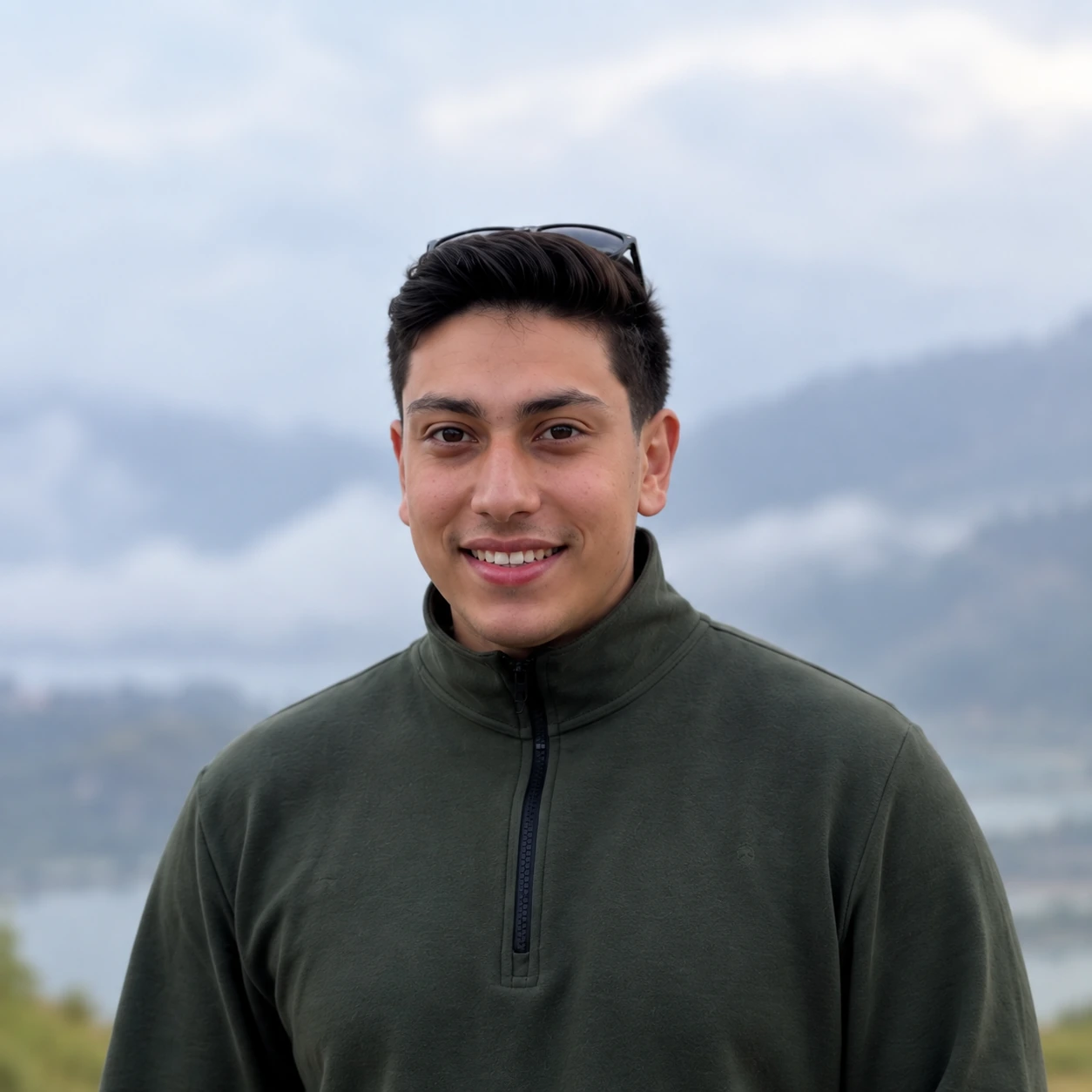
Mohammad Zbeeb
I study how large language models learn to reason and how those capabilities can be transferred between models. My work spans post-training, model merging, speculative decoding, and model evaluation and alignment.
I am currently working with Aleksander Madry on a research project in stealth. Previously, I worked with the Image and Video Understanding Lab at KAUST and Edgebot's post-training team.
I graduated from the American University of Beirut with a degree in computer and communication engineering, and have co-instructed courses there on machine learning and AI in medicine.
Research interests. I am particularly interested in how training data, initialization, and supervision shape reasoning and generalization. My current interests include reinforcement learning, knowledge distillation, and more efficient training and inference.
Experience
Research Scientist — working with Aleksander Madry on a project in stealth.
Research Engineer, Edgebot — post-training team.
Visiting Researcher, KAUST — Image and Video Understanding Lab.
Research Staff and Co-instructor, American University of Beirut — courses in machine learning and AI in medicine.
ML Engineer, Chimera Cybersecurity.
Publications
* Equal contribution. ‡ Equal advising authors.
-
Arabic Safety Alignment as Selective Refusal: An Empirical Study of SFT, DPO, and Guard Calibration
EMNLP · Oral
paper conferencesummary of Arabic Safety Alignment as Selective Refusal: An Empirical Study of SFT, DPO, and Guard Calibration
We study selective refusal across five Arabic-capable language models and 130 runs, measuring refusals on benign and harmful prompts separately. Refusal-only SFT tends toward blanket refusal; selected mixtures of helpful and refusal examples recover a better trade-off. DPO and inference guards have model-dependent effects, and transfer to Arabizi remains partial. The study supports choosing and validating operating points for each model and deployment objective. Refusal rates alone do not establish response safety.
-
TAPS: Task Aware Proposal Distributions for Speculative Sampling
SPIGM Workshop at ICML 2026
paper code models datasummary of TAPS: Task Aware Proposal Distributions for Speculative Sampling
We investigate how draft training data shapes speculative decoding with HASS and EAGLE-2 drafters. MathInstruct and ShareGPT produce specialists for different workloads, while mixed-data training broadens coverage without consistently benefiting from a larger mixture. Combining specialists at inference time through confidence routing or merged-tree verification outperforms checkpoint averaging. We evaluate accepted draft tokens per verifier call on conversational and reasoning benchmarks; the study does not establish an end-to-end latency improvement.
-
AraLingBench: A Human-Annotated Benchmark for Evaluating Arabic Linguistic Capabilities of Large Language Models
EACL 2026 · Oral
paper code datasummary of AraLingBench: A Human-Annotated Benchmark for Evaluating Arabic Linguistic Capabilities of Large Language Models
AraLingBench contains 150 expert-authored multiple-choice questions, evenly covering grammar, morphology, spelling, reading comprehension, and syntax. Evaluation of 35 Arabic and bilingual models reveals uneven linguistic competence: spelling and reading comprehension are generally stronger than syntax and morphology. General benchmark scores and human difficulty labels do not fully describe these gaps. The benchmark provides a compact diagnostic of structural language skills, with its small size and multiple-choice format limiting the conclusions that can be drawn.
-
Hala Technical Report: Building Arabic-Centric Instruction & Translation Models at Scale
EACL 2026
paper project models & datasummary of Hala Technical Report: Building Arabic-Centric Instruction & Translation Models at Scale
HALA builds Arabic-centric instruction and translation models through a translate-and-tune pipeline. An FP8 teacher creates bilingual supervision for a lightweight LFM2-1.2B translator, which translates English instruction datasets into a corpus of roughly 4.5 million samples. Fine-tuning and spherical interpolation with base checkpoints produce models at 350M, 700M, 1.2B, and 9B parameters. Evaluation across six Arabic benchmarks shows improvements in average scores over their corresponding base models. The released collection includes models and datasets.
-
Reasoning Vectors: Transferring Chain-of-Thought Capabilities via Task Arithmetic
arXiv preprint · 2025
paper modelssummary of Reasoning Vectors: Transferring Chain-of-Thought Capabilities via Task Arithmetic
We extract a reasoning vector by subtracting an SFT checkpoint from a compatible GRPO-trained checkpoint and transfer it to instruction-tuned models through parameter addition. Experiments with Qwen2.5 at 1.5B and 7B show gains across mathematical reasoning and code generation, with further gains from step-by-step prompting. Subtraction, scaling, and perturbation experiments probe the effect of the vector. Transfer requires compatible architectures, tokenizers, and initializations; single-run results leave statistical significance to further evaluation.
-
Exploring the Landscape for Generative Sequence Models for Specialized Data Synthesis
Journal of Data Analytics and Engineering Decision Making · 2024
paper codesummary of Exploring the Landscape for Generative Sequence Models for Specialized Data Synthesis
We encode numerical network-traffic features as symbolic sequences and treat structured data synthesis as next-symbol prediction. The study compares a WaveNet-inspired model, a recurrent neural network, and a Transformer decoder. A one-class SVM measures how often generated samples fall within the learned real-data distribution; the RNN achieves the highest reported inlier rate, 87.9%. The paper also surveys synthetic-data applications, privacy techniques, and evaluation approaches. Inlier rates are a diagnostic rather than a complete measure of downstream utility or privacy.